
The short answer
For many people with long-running muscle and joint aches, daily red and near-infrared light helps — gradually. It does not help everyone, and it is not a cure. The strongest research is for knees and necks; the research for backs is more mixed.
How is it supposed to work?
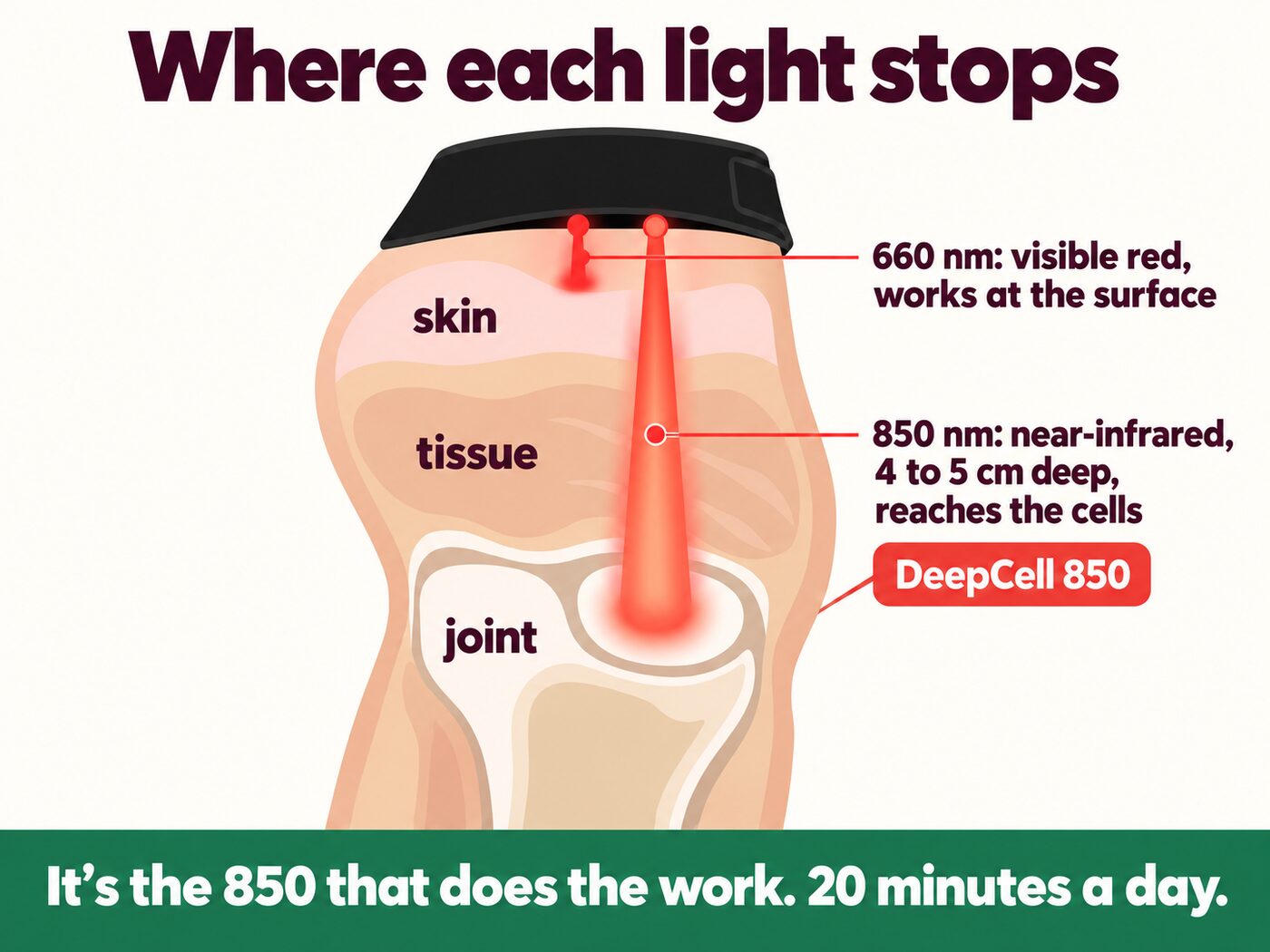
Red light (around 660nm) and near-infrared light (around 850nm) pass into the skin and are absorbed by the mitochondria, the parts of your cells that make energy. Researchers call this photobiomodulation. According to a widely cited review by Harvard's Wellman Center for Photomedicine, one of its most reproducible effects is a reduction in inflammation — particularly relevant for joints.5 Near-infrared light reaches deeper than red, which is why many devices, including LumaWrap, use both.
What the research found
| Area | What reviews found | Our honest rating |
|---|---|---|
| Knee | 22 trials: less pain than placebo at the right dose1 | Encouraging |
| Neck | Less pain than placebo, lasting weeks in chronic neck pain2 | Encouraging |
| Lower back | One review: lower pain scores3. A later review: small effect4 | Mixed |
| Weight loss | We don't rely on these claims | Walk past |
Two cautions. First, most trials used clinic lasers or LEDs rather than home wraps, so they show what is possible rather than guarantee a result. Second, "less pain on average" means some people improved a lot and some barely at all.
Is it just a placebo?
This is a fair question. The better trials compared real light with a "sham" device that looked identical but gave out no therapeutic light. For knees and necks, real light still came out ahead.1,2 For backs, the gap was small in the most recent review.4
What makes the difference between "worked" and "didn't"
- Wavelength. 660nm red and 850nm near-infrared are among the most studied. Many cheap devices do not say what they use. See 660nm vs 850nm.
- Skin contact. Clothing blocks much of the light. Always use it on bare skin.
- Consistency. Daily for weeks beats occasional long sessions.
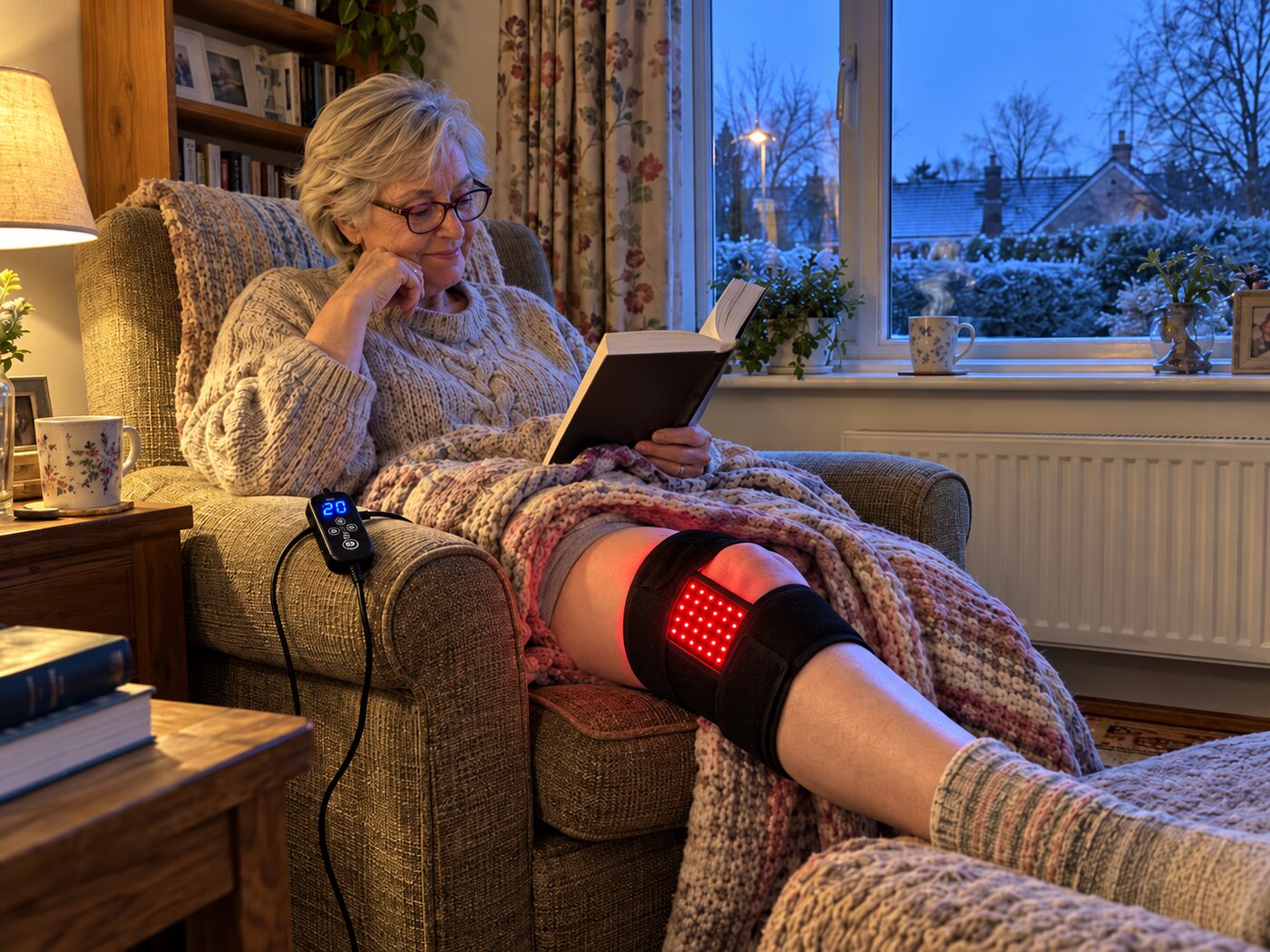
- The right dose. Light therapy has a sweet spot; far more is not better.5 That is why LumaWrap switches off after 20 minutes.
- The right problem. Stiff, aching joints and tired muscles — not a new injury or unexplained pain, which needs your GP.
A fair four-week test
- Before you start, score the ache out of 10 on waking and in the evening. Note what you struggle with — stairs, gardening, getting out of a chair.
- Use it every day for 20 minutes, at the same time each day.
- Rescore every Sunday and write it down.
- Judge at week four to six, not day three.
- Keep doing whatever your GP or physio has recommended — light therapy is an addition, not a replacement.
With LumaWrap you have 90 days to do this. If it is not for you, send it back for a full refund. See returns and refunds.
Who it is not for
Speak to your GP before trying it if you are pregnant, have a pacemaker, take light-sensitising medication, have or have had cancer, or have pain that is new, severe or unexplained. More detail in is red light therapy safe? and side effects.
Common questions
Does red light therapy really work?+
For some problems the research is encouraging. Reviews of placebo-controlled trials found reduced knee pain and neck pain after light therapy. For lower back pain the results are mixed. It works gradually, over weeks, and not for everyone.
How long does red light therapy take to work?+
Most people who notice a difference do so after two to six weeks of daily sessions. A handful of sessions spread over a month is not a fair test.
Is red light therapy just a placebo?+
The main reviews compared real light with fake (sham) light that looked the same, and still found a difference for knee and neck pain. That is what separates it from a placebo. For back pain the gap was small.
Do red light therapy belts work for weight loss?+
We do not make that claim and would be cautious of anyone who does. LumaWrap is designed for everyday aches and stiffness, not fat loss.
Why does red light therapy not work for some people?+
The usual reasons are irregular use, wearing it over clothing, devices without stated wavelengths, using too much, or a problem that needs a GP rather than a gadget.
Does red light therapy work for arthritis?+
We cannot say it treats arthritis. What we can say is that a 2019 BMJ Open review of knee osteoarthritis trials found reduced pain compared with placebo. Always follow your GP's advice for any diagnosed condition.
Is it worth trying?+
If you have long-running aches and have tried heat pads and gels, it can be worth a fair four-week test. LumaWrap has a 90-day money-back guarantee, so you can try it without risk.
Related reading
Sources and how we wrote this guide
We read the published research and summarise it in plain English, including the studies that found little or no effect. LumaWrap is a wellbeing device, not a medical treatment. If you have a health condition, speak to your GP first.
- 1.Efficacy of low-level laser therapy on pain and disability in knee osteoarthritis: systematic review and meta-analysis of randomised placebo-controlled trials — BMJ Open (Stausholm et al.), 2019.Across 22 placebo-controlled trials, light therapy at the recommended doses reduced knee pain compared with placebo, alongside exercise.
- 2.Efficacy of low-level laser therapy in the management of neck pain: a systematic review and meta-analysis — The Lancet (Chow et al.), 2009.Light therapy reduced neck pain straight after treatment and for up to 22 weeks in chronic neck pain, compared with placebo.
- 3.The effectiveness of low-level laser therapy for nonspecific chronic low back pain: a systematic review and meta-analysis — Arthritis Research & Therapy (Huang et al.), 2015.Across seven trials, pain scores were lower after light therapy than placebo, though disability and movement scores did not change significantly.
- 4.Photobiomodulation therapy does not decrease pain and disability in people with non-specific low back pain: a systematic review — Journal of Physiotherapy (Tomazoni et al.), 2020.Across 12 trials, the effect on back pain versus placebo was small. We include this so you see the mixed evidence, not just the good news.
- 5.Mechanisms and applications of the anti-inflammatory effects of photobiomodulation — AIMS Biophysics (Hamblin, Harvard Medical School), 2017.Red and near-infrared light is absorbed in the cell's mitochondria; one of the most reproducible effects is an overall reduction in inflammation. Too much light can reverse the benefit.