
The 30-second answer
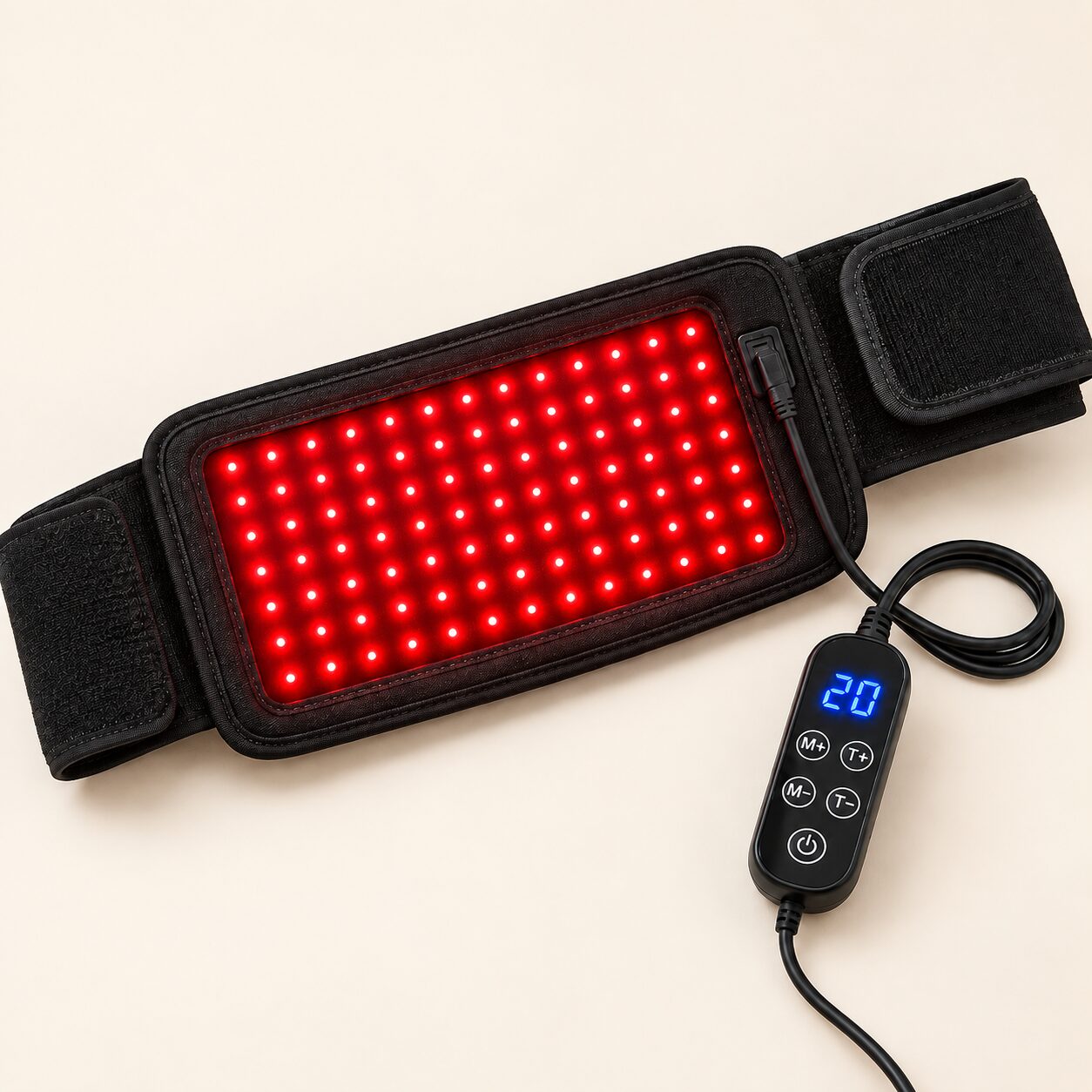
A red light therapy belt is a flexible strap lined with LEDs that shine red and often near-infrared light onto your skin. People use them at home for everyday aches and stiffness in the back, knees, hips and shoulders. A sensible belt lists both main wavelengths, has an automatic timer, fits the area you need and comes from a seller who will take it back if it does not suit you. It is a wellbeing device, not a medical treatment.
Types of red light belt
| Type | What it is | Best for |
|---|---|---|
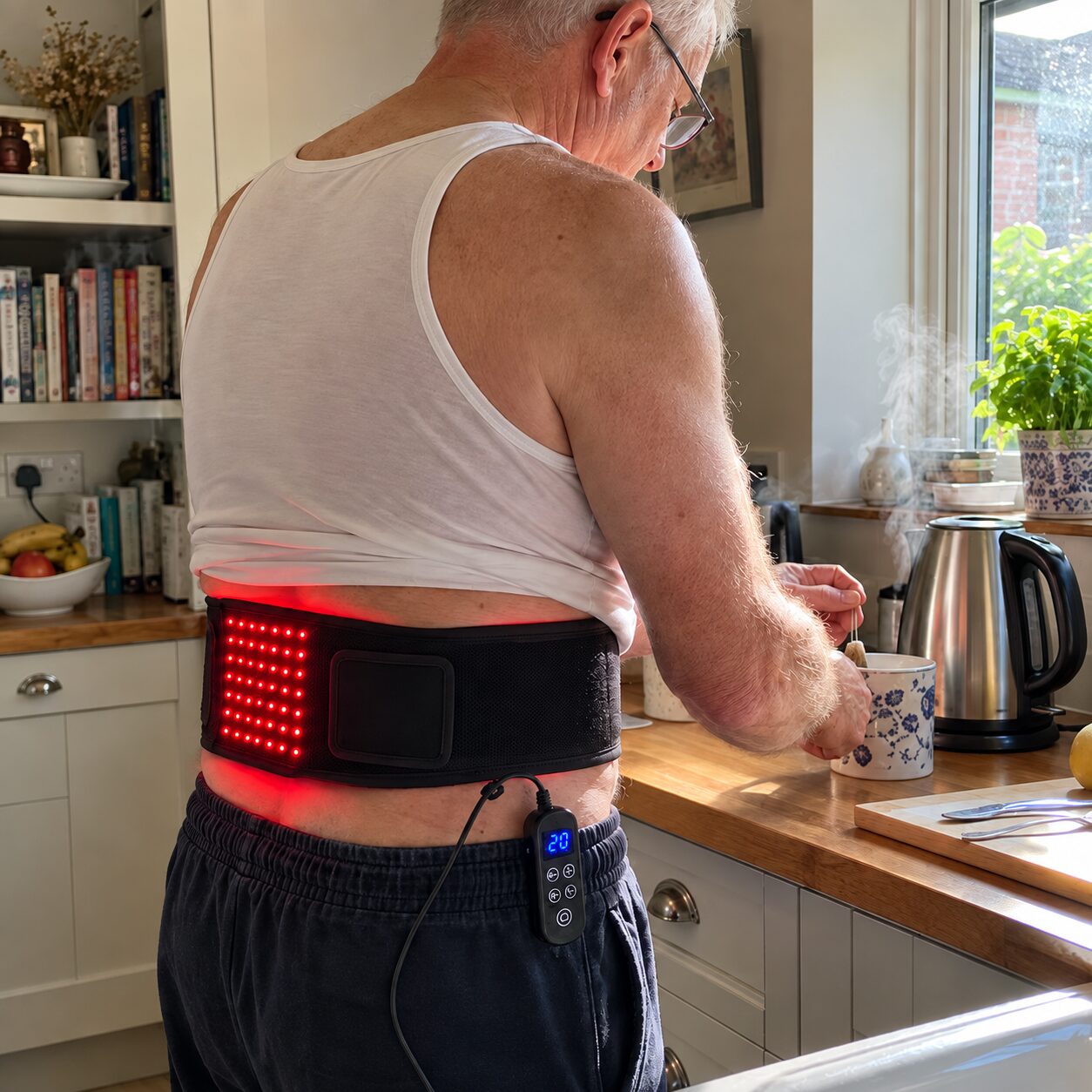
| Waist or back belt | A long strap that goes round the middle | Lower back |
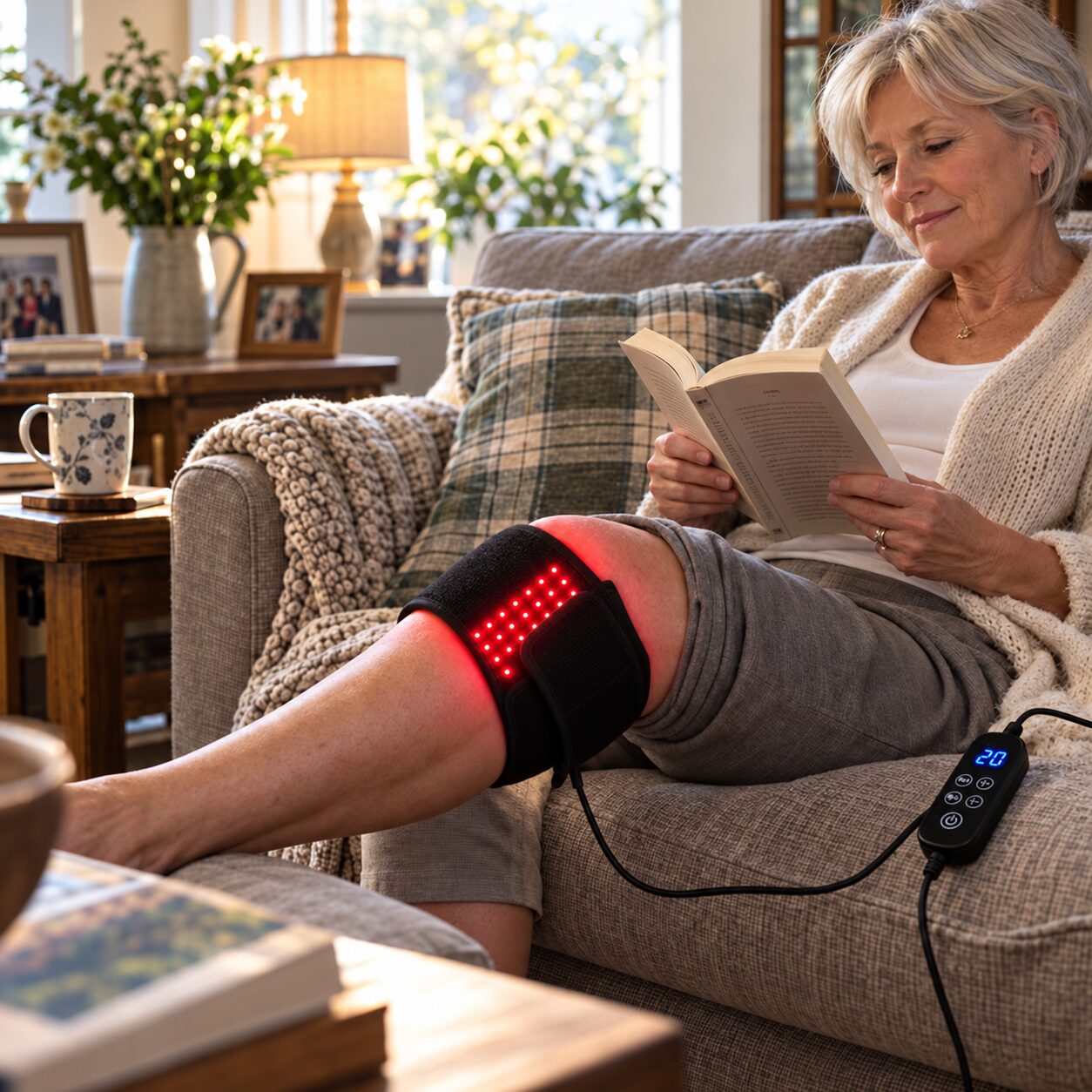
| Knee and joint wrap | A shorter wrap that curves round a joint | Knees, elbows, shoulders |
| Flexible pad | A flat panel you lay on or hold in place | Neck, hips, larger areas |
Many people have more than one sore spot, so a wrap with an adjustable strap that moves between areas is often more useful than a belt that fits only one.
What the numbers mean
Wavelength (nm)
Wavelength is measured in nanometres (nm). The two most common in belts are 660nm, a visible red that works near the surface of the skin, and 850nm, an invisible near-infrared that travels deeper. Belts that list only one are covering only one depth. Read 660nm vs 850nm explained.
Session timer
Research has generally used set sessions repeated over weeks, and more light is not always better. A belt that counts down and switches itself off keeps your sessions consistent and means you cannot leave it on by accident.
Power
Check it comes with a UK plug or runs from USB. Belts shipped from overseas sometimes arrive with a foreign plug or no adaptor at all.
LED count and brightness
Some sellers advertise large LED counts or power figures. These are hard to compare between brands because they are measured in different ways. Wavelengths, a timer, fit and the seller's returns are more reliable things to compare.
The five things that matter most
- Both wavelengths. 660nm and 850nm, clearly written on the listing or box.
- A fixed session with automatic shut-off. Consistent, and safe if you nod off.
- The right fit. An adjustable strap for the area you actually need.
- A UK seller with a long trial. Light therapy takes weeks, so a 14-day return window is too short to judge it.
- Honest claims. No weight loss, no "cures", no promises of results in a day.
Checklist: compare any belt
| Check | What good looks like | LumaWrap |
|---|---|---|
| Wavelengths | Both 660nm and 850nm clearly listed | Yes — 660nm and 850nm |
| Session timer | Switches itself off after a set time | Yes — 20 minutes |
| Power | UK plug or USB included | Yes — UK mains adaptor and USB cable |
| Fit | Adjustable strap for the area you need | Knee, hip, back, shoulder, elbow |
| Returns | At least 30 days, ideally longer | 90 days, full refund |
| Warranty | At least 1 year | 2 years |
| Seller | UK contact and address | UK brand, UK email support |
| Claims | No weight-loss, cure or miracle claims | Wellbeing device only |
Red flags to walk away from
- Weight-loss, "fat burning" or "detox" claims.
- Claims to cure or treat a disease.
- No UK address, phone or email for the seller.
- Hundreds of five-star reviews that all sound the same.
- Countdown timers that reset when you reload the page.
- No mention of who should not use it.
UK seller or overseas marketplace?
| UK seller | Overseas marketplace seller | |
|---|---|---|
| Delivery | Usually a few working days | Can take weeks |
| Plug | UK plug expected | May need an adaptor |
| Returns | UK address, UK consumer rights | Can mean posting abroad |
| Support | UK contact | Varies |
Not every overseas seller is poor, and not every UK seller is good — but check before you buy.
How to use a red light belt safely
- Place it on bare, clean, dry skin — no creams or gels underneath.
- Fasten it snugly so the lit panel sits flat against the area.
- Run one session (about 20 minutes) and let it switch itself off.
- Once a day per area. Keep going for four to six weeks before judging.
- Stop if it feels too hot, and never use it over the eyes.
Speak to your GP first if you are pregnant, have a pacemaker or implant near the area, take light-sensitising medication, or have or have had cancer. See is red light therapy safe?
Where LumaWrap sits
We built LumaWrap to meet every point on the checklist above. It is a flexible wrap rather than a waist-only belt, so one wrap moves between knee, hip, back and shoulder.
| Bundle | Price | Per wrap |
|---|---|---|
| 1 LumaWrap | £139 | £139.00 |
| 2 LumaWraps | £297 | £148.50 |
| 3 LumaWraps | £349 | £116.33 |
Free UK delivery, dispatched within 24 hours, 90 days to return it and a 2-year warranty. See what is LumaWrap? for the full details.
What the research says
Red and near-infrared light has been studied for decades. Results are mixed: some trials, such as one on knees, report benefits, while research on lower backs has found smaller or uncertain effects. We list the studies below so you can read them yourself. For the full picture, read does red light therapy work?
Common questions
What should I look for in a red light therapy belt?+
Both 660nm red and 850nm near-infrared light clearly listed, an automatic session timer, a UK plug or USB power, a strap that fits the area you need, and a UK seller with a long returns period and a warranty.
Do red light therapy belts work for weight loss?+
Be wary of any belt sold for weight loss or 'fat burning'. That is not what LumaWrap is for, and we do not make that claim. Treat it as a red flag when a seller does.
Can you use a red light therapy belt over clothes?+
No. Clothing blocks a large share of the light. Use a belt on bare, clean, dry skin.
How much does a red light therapy belt cost in the UK?+
Prices vary widely between shops. Basic single-wavelength belts are often cheaper; dual-wavelength wraps with a timer, UK warranty and long returns usually cost more. LumaWrap is £139 for one, with free UK delivery.
How often should I use a red light belt?+
Once a day per area for about 20 minutes is a common routine. More is not better. Give it four to six weeks before judging it.
Can I sleep wearing a red light belt?+
We do not recommend wearing any belt in bed overnight. Choose one with an automatic shut-off so nodding off during a session is not a problem.
Is a red light belt good for back pain?+
Research on red light for lower back pain is mixed — some studies report benefits, others find small or uncertain effects. Staying active comes first; a belt is something you can try alongside.
What is the best red light therapy belt in the UK?+
The best one is the one that fits the area you need, lists both wavelengths, switches itself off and comes from a UK seller who will take it back if it is not for you. Use the checklist on this page to compare any belt, including ours.
Related reading
Sources and how we wrote this guide
We read the published research and summarise it in plain English, including the studies that found little or no effect. LumaWrap is a wellbeing device, not a medical treatment. If you have a health condition, speak to your GP first.
- 1.Mechanisms and applications of the anti-inflammatory effects of photobiomodulation — AIMS Biophysics (Hamblin, Harvard Medical School), 2017.Red and near-infrared light is absorbed in the cell's mitochondria; one of the most reproducible effects is an overall reduction in inflammation. Too much light can reverse the benefit.
- 2.Efficacy of low-level laser therapy on pain and disability in knee osteoarthritis: systematic review and meta-analysis of randomised placebo-controlled trials — BMJ Open (Stausholm et al.), 2019.Across 22 placebo-controlled trials, light therapy at the recommended doses reduced knee pain compared with placebo, alongside exercise.
- 3.The effectiveness of low-level laser therapy for nonspecific chronic low back pain: a systematic review and meta-analysis — Arthritis Research & Therapy (Huang et al.), 2015.Across seven trials, pain scores were lower after light therapy than placebo, though disability and movement scores did not change significantly.
- 4.Photobiomodulation therapy does not decrease pain and disability in people with non-specific low back pain: a systematic review — Journal of Physiotherapy (Tomazoni et al.), 2020.Across 12 trials, the effect on back pain versus placebo was small. We include this so you see the mixed evidence, not just the good news.