
The short answer
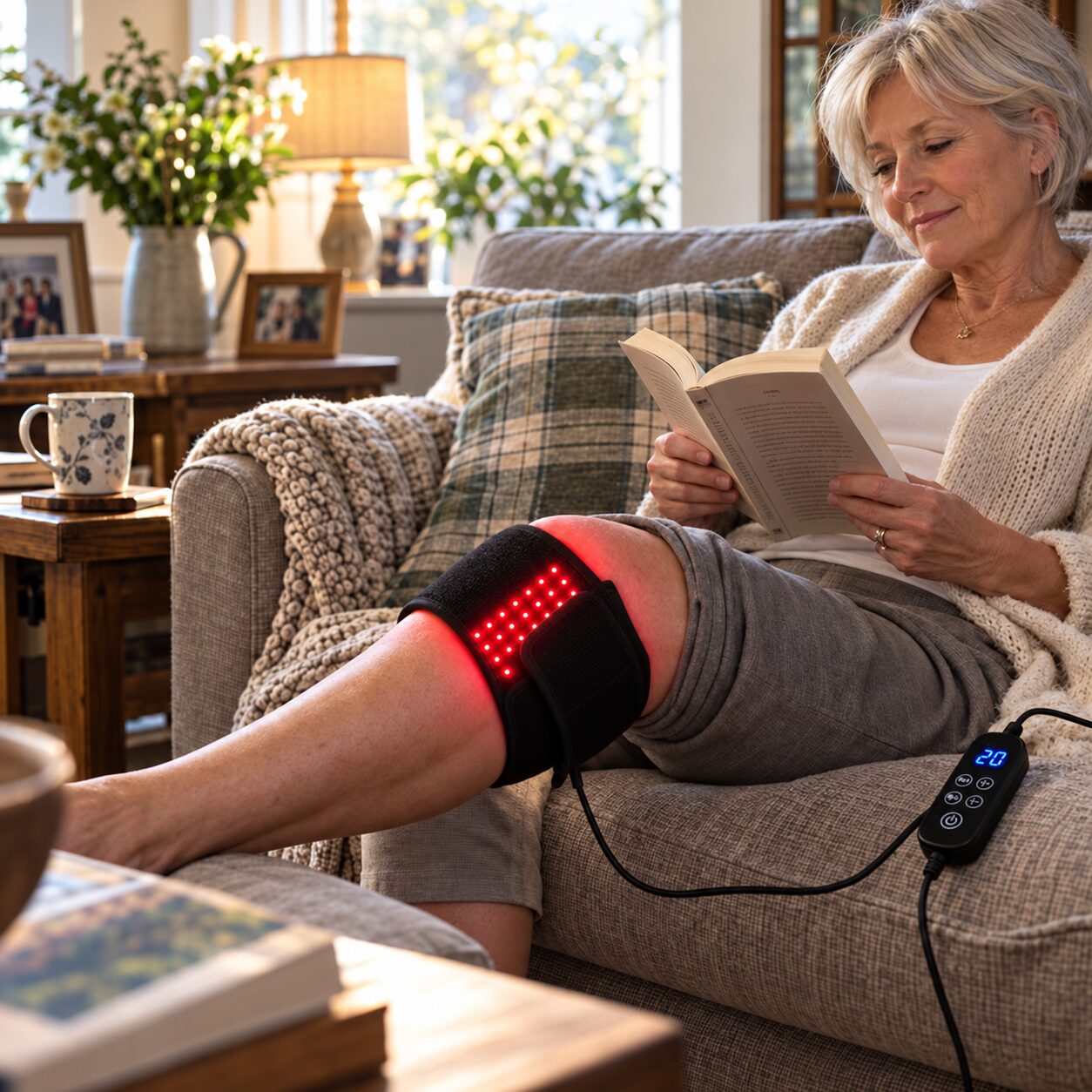
Red light therapy is a gentle, drug-free way to add warmth and comfort to a stiff or aching knee at home. Some research on knees has reported less pain and stiffness after several weeks, though not every study agrees. It is not a painkiller and will not fix a damaged joint, but many people find a daily 20-minute session a pleasant part of looking after their knees.
Why people try it on their knees
The knee is an easy joint to wrap. It sits close to the skin, with less padding over it than a hip, so the strap goes round, the panel lies flat and you can sit down for the whole session. LumaWrap uses two kinds of light: 660nm red, which works near the surface, and 850nm near-infrared, which travels deeper. Read 660nm vs 850nm explained.
Where to put the panel
| Where it aches | Where the panel goes |
|---|---|
| Front of the knee | Centred just below the kneecap |
| Inner side | Turned towards the inside of the knee |
| Outer side | Turned towards the outside of the knee |
| Behind the knee | Over the back of the knee, with the strap across the front |
| All round, stiff | Front first; move it to the side another day |
Fasten it snugly but comfortably — you should be able to slide a finger under the strap. Sit with your leg straight or slightly bent and supported.
How long and how often
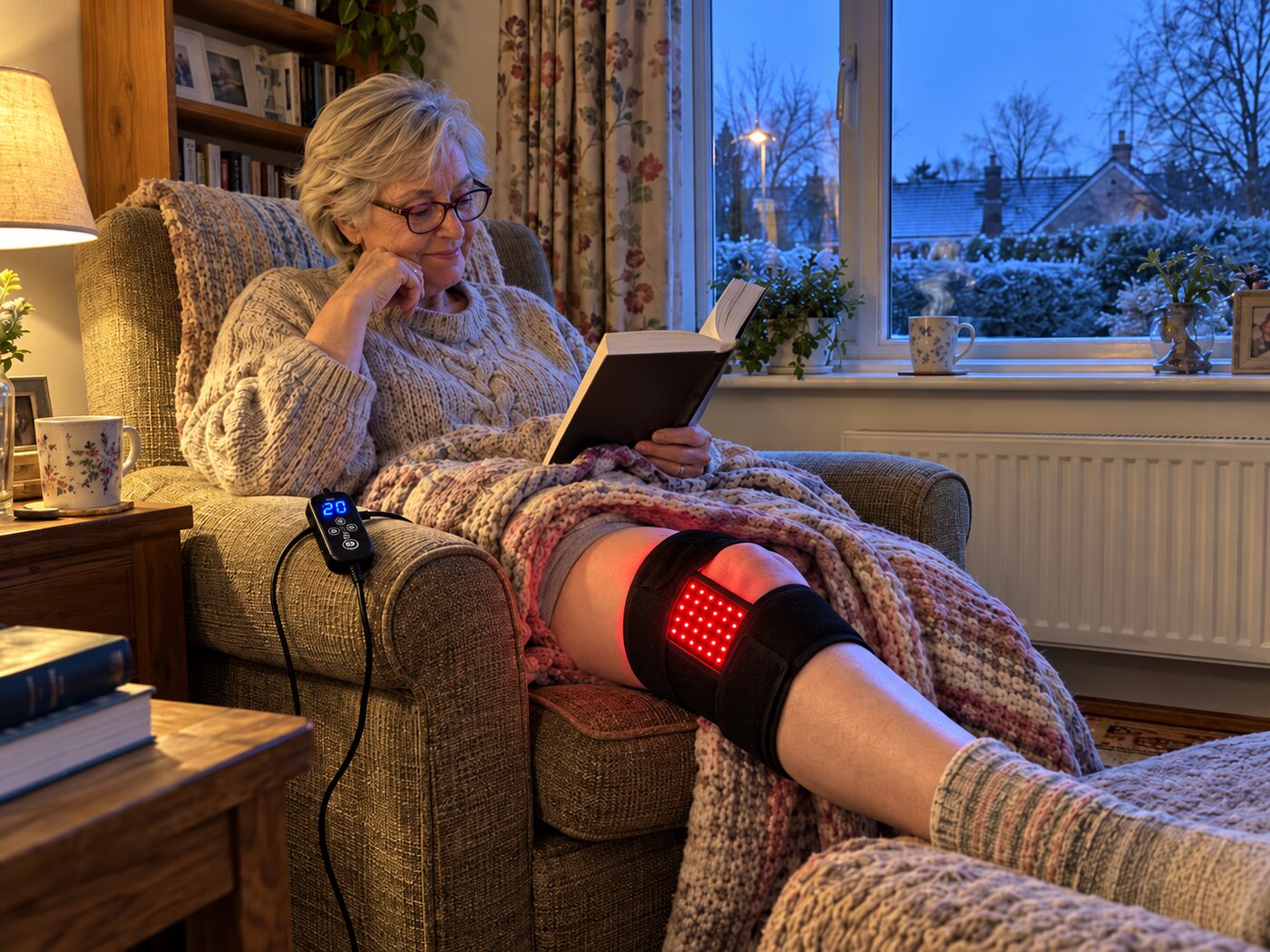
One 20-minute session a day per knee is plenty. Doing more is not better. The regular routine over weeks matters more than any single session.
| Day | What to do |
|---|---|
| Day 1 | One session. Check the warmth feels comfortable. |
| Days 2–3 | One session a day, same time if you can. |
| Days 4–7 | Keep going daily. Jot down how the knee feels each morning. |
What to expect, week by week
- Days 1–3: gentle warmth and a relaxing twenty minutes. Nothing else yet, and that is normal.
- Weeks 1–2: some people notice their knee feels a little looser in the mornings.
- Weeks 4–6: the time to judge it fairly. Compare your diary with how you felt at the start.
Everyone is different, and some people notice little change. That is why you have 90 days to send it back.
Fitting it into your day
- Morning stiffness: a session with your first cup of tea.
- After a walk: twenty minutes with your feet up when you get home.
- Evening: on the sofa with the television or a book.
What to do alongside it
A wrap works best as one part of looking after your knees, not instead of it. Keep moving — gentle walking, swimming or cycling — and do the simple strengthening exercises your GP or physio suggests. Keeping to a healthy weight also takes pressure off the knees. Use the wrap as a comfortable daily habit alongside these.
Safety: who should check first
Speak to your GP before using a red light wrap if you:
- have had a knee replacement or have metal implants in the knee;
- are pregnant, or have a pacemaker;
- take medicine that makes you sensitive to light;
- have, or have had, cancer.
See a GP instead if your knee
- is hot, red or badly swollen;
- locks, gives way or you cannot put weight on it;
- started hurting after a fall or injury;
- comes with a fever or you feel unwell.
More in is red light therapy safe?
What the research says
A 2019 trial published in BMJ Open looked at light therapy for knee pain and reported some benefit, while other studies have found smaller or unclear effects. Researchers think red and near-infrared light may affect how cells use energy, but this is still being studied. We list the sources below so you can read them yourself. For the wider picture, see does red light therapy work?
Common questions
Does red light therapy work for knee pain?+
Some research, including a 2019 trial on knees, has reported less knee pain and stiffness, while other studies are less clear. It is not a painkiller: any change builds gradually over four to six weeks of daily use.
How long should I use red light therapy on my knee?+
One 20-minute session a day on bare skin. Longer sessions do not add benefit, which is why LumaWrap switches itself off at 20 minutes.
Where exactly should the wrap sit on the knee?+
Centre the lit panel over the part that aches — usually the front, just below the kneecap — and fasten the strap snugly behind the joint. If the ache is on the inner or outer side, turn the panel that way.
Can I use it if I have had a knee replacement?+
Speak to your GP or surgeon first. Light therapy over an implant is not automatically a problem, but it is a conversation to have with the person who knows your knee.
Can I do both knees?+
Yes, one after the other with one wrap, or both at once with two. Many people choose the two-wrap bundle for this reason.
Can I wear it over trousers or tights?+
No. Clothing blocks much of the light. Roll up your trousers or wear shorts so the panel sits on bare skin.
Can I use it if I have arthritis in my knee?+
Many people with stiff, aching knees use a wrap alongside the advice from their GP or physio. LumaWrap is a wellbeing device and does not treat arthritis or any disease. If you are unsure, ask your GP first.
How soon will I notice anything?+
Most people feel gentle warmth in the first sessions. Any easing of stiffness tends to be gradual, so give it four to six weeks of daily use before you decide — you have 90 days to return it.
Related reading
Sources and how we wrote this guide
We read the published research and summarise it in plain English, including the studies that found little or no effect. LumaWrap is a wellbeing device, not a medical treatment. If you have a health condition, speak to your GP first.
- 1.Efficacy of low-level laser therapy on pain and disability in knee osteoarthritis: systematic review and meta-analysis of randomised placebo-controlled trials — BMJ Open (Stausholm et al.), 2019.Across 22 placebo-controlled trials, light therapy at the recommended doses reduced knee pain compared with placebo, alongside exercise.
- 2.Mechanisms and applications of the anti-inflammatory effects of photobiomodulation — AIMS Biophysics (Hamblin, Harvard Medical School), 2017.Red and near-infrared light is absorbed in the cell's mitochondria; one of the most reproducible effects is an overall reduction in inflammation. Too much light can reverse the benefit.